+8618702197143
Choosing the right Wood Cabinet Display requires more than matching a stain to a showroom wall. It requires evidence, context, and careful observation. The display should show how wood looks under warm LEDs, daylight, and changing viewing angles. Small details matter. Grain direction, edge quality, hinge movement, and drawer alignment quickly reveal manufacturing standards.
Industry data supports this careful approach. The 2024 Houzz U.S. Kitchen Trends Study reported that 76% of renovating homeowners upgraded their cabinetry. That figure shows how strongly cabinets influence renovation decisions. Grand View Research also identifies steady growth in the global kitchen cabinets market, driven by remodeling, customization, and premium materials. These trends make a Wood Cabinet Display an important sales and specification tool, not merely a decorative sample.
A reliable display should present material facts clearly. Include the wood species, finish type, moisture guidance, hardware grade, maintenance requirements, and approximate lead time. The National Kitchen & Bath Association’s 2024 Design Trends Research emphasizes personalization, storage performance, and durable kitchen solutions. A strong display should therefore demonstrate more than appearance. Open one drawer. Touch the finish. Inspect the joint.
Looks can deceive.
A dark walnut finish may hide uneven grain. A pale oak sample may exaggerate surface variation under bright lighting. These imperfections deserve attention, not concealment. Product claims should be supported by manufacturer specifications, test documentation, and consistent sample labeling. The best selection balances visual warmth, structural performance, budget, and long-term care. It also admits uncertainty, because real wood naturally changes with light, humidity, and time.
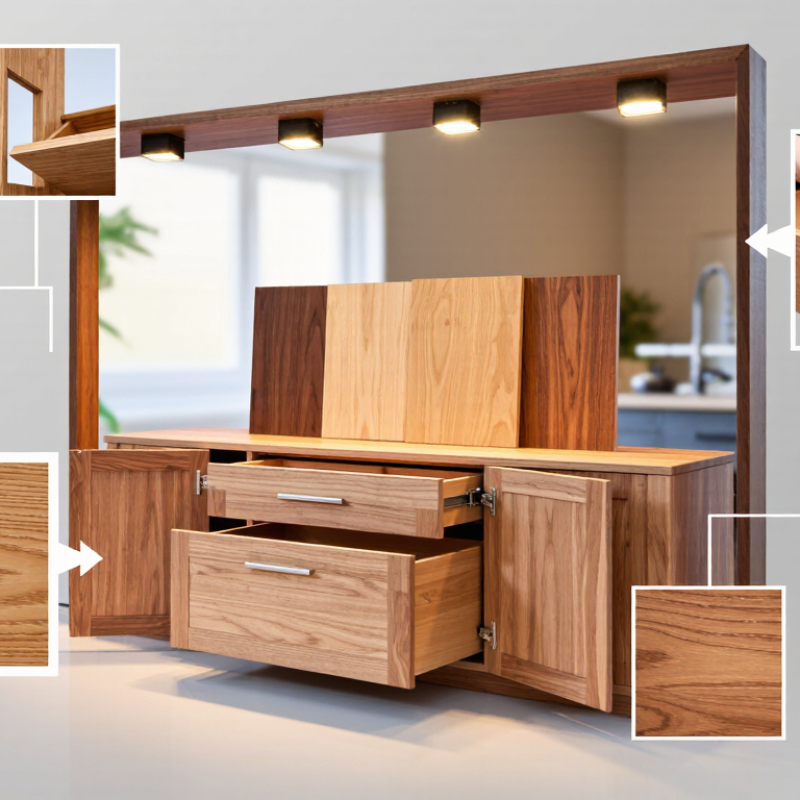
How to Choose the Right Wood Cabinet Display?
Define cabinet use, load, and display capacity before comparing options. A cabinet for fragile ceramics needs different support than one for books or tools. Decide who will use it, how often, and where it will stand. A busy showroom may need wide doors and quick access. A private study may value quieter hinges and deeper shelves. That changes everything.
Measure the heaviest item, not the average one. Record its weight, width, height, and contact area. A concentrated load can stress a shelf more than several lighter objects. Look for solid shelf supports, strong joinery, and a back panel that resists movement. Adjustable shelves help, but excessive spacing can reduce stability. Leave room for future items. Display capacity is more than shelf count.
In my experience, many cabinet choices fail because appearance leads the decision. I once underestimated how often a display would be rearranged. The finish looked excellent, but the shallow shelves limited practical use. Check stated load data and ask how it was tested. If details are missing, use a conservative safety margin. Consider room humidity, floor level, door clearance, and visibility from normal standing height. A careful sketch can reveal problems before purchase. Measure twice.

Define the cabinet use, expected shelf load, and required display capacity before comparing cabinet options.
These representative planning benchmarks compare common cabinet formats using typical shelf dimensions. Wall-mounted cabinets suit lightweight, limited displays; freestanding and tall cabinets provide more usable display area; heavy-duty cabinets support larger or denser objects. Always confirm the actual load rating with the cabinet specification and wall or floor fixing method.
Select wood species by Janka hardness, ranging from 660 to 3,220 lbf. The Janka rating measures the force needed to embed a steel ball into wood. A lower rating, such as 660 lbf, usually indicates softer wood with easier cutting and a warmer, more relaxed appearance. Higher ratings, reaching 3,220 lbf, resist dents and wear better. This matters for cabinet displays handled often, especially in busy rooms.
In practical work, I compare hardness with the display’s purpose. Softer species may suit decorative doors, while harder wood can support shelves, frames, and frequently touched edges. However, hardness does not guarantee stability. Moisture, grain direction, joinery, and finishing quality also affect performance. I once focused too heavily on hardness and overlooked wood movement. That shortcut failed. A strong species can still crack when poorly dried or fitted.
Tips: Match the Janka rating to daily use, not appearance alone. Around 660–1,000 lbf may work for light-use displays. Species near 1,400–1,900 lbf offer a balanced choice for regular handling. Extremely hard wood, near 3,220 lbf, can resist impacts but may require sharper tools and more careful machining. Ask for verified hardness data, inspect sample grain, and check moisture content before ordering. A small sample reveals more than a showroom photograph.
How to Choose the Right Wood Cabinet Display?
Verify 8–12% Moisture Content and 40–60% Relative Humidity Stability
When selecting a wood cabinet display, inspect moisture before judging its finish. Wood can look perfect while holding hidden movement risks. Aim for 8–12% moisture content in the cabinet panels and frames. Use a calibrated moisture meter, not a visual estimate. Test several areas, including corners, doors, and rear panels. Record the readings. A single reading misleads.
Before installation, allow the cabinet to acclimate inside the intended room. Store it flat, protected from heaters, windows, and damp floors. Do not trust packaging alone. Keep relative humidity between 40% and 60%, with minimal daily fluctuation. Stable air matters more than briefly reaching an ideal number. Rapid changes can cause swelling, shrinking, open joints, or sticking doors.
Place a reliable hygrometer near the display, away from direct airflow. Check it during humid and dry weather. Small details matter. Experienced installers also inspect wall conditions, because moisture can migrate from masonry or unfinished surfaces. I would not approve installation from one test alone. Meters can drift, and wood varies by species and thickness. Recheck questionable pieces after acclimation. If readings remain outside range, delay installation and investigate the room environment. That pause prevents expensive corrections.
How to Choose the Right Wood Cabinet Display?
Compare Joinery, 18–19 mm Panels, and Hardware Load Ratings
When I inspect a wood cabinet display, I start with the joints rather than the finish. A clean surface can hide weak construction. Look for tight dados, reinforced dowels, or well-fitted mortise-and-tenon connections. Loose joints often reveal themselves through small gaps, racking, or a soft creak. Still, joinery alone does not guarantee durability.
Panel thickness matters because shelves and side walls carry different stresses. Panels around 18–19 mm provide a useful balance between rigidity, weight, and usable interior space. However, thickness is not strength by itself. Core density, grain direction, edge support, and shelf span can change performance. I once approved a thick shelf that sagged because its span was too wide. That mistake changed my inspection checklist. Measure unsupported distance, not only panel thickness.
Check every hinge, bracket, runner, and shelf pin against its stated load rating. Use ratings for the actual mounting position, not a showroom sample. Static capacity may not reflect repeated opening, vibration, or uneven loading. Calculate the weight of glassware, books, and display objects together. Leave a sensible margin. Fasteners must enter sound material, not weak edges or hollow sections. On site, I test doors repeatedly and inspect movement after loading. My judgment is still cautious, because real use is rarely as gentle as a factory test.
| Evaluation Dimension | What to Look For | Typical Specification or Range | Practical Effect | Recommended Choice |
|---|---|---|---|---|
| Joinery: Dado or Rabbet | A panel is seated in a continuous groove cut into the adjoining component. | Common groove depth: approximately 6–10 mm, depending on panel thickness and construction. | Provides mechanical support and helps keep cabinet parts aligned; glue can improve the joint. | Good for cabinet sides, bottoms, and fixed shelves where strength and alignment matter. |
| Joinery: Dovetail | Interlocking, tapered pins and tails, most often used in drawers. | Typically used at drawer corners rather than throughout the cabinet carcass. | Resists the pulling forces created when a loaded drawer is opened repeatedly. | Prefer for frequently used or heavily loaded drawers; confirm accurate machining and smooth movement. |
| Joinery: Mortise and Tenon | A projecting tenon fits into a matching mortise. | Often used for solid-wood frames, doors, and face-frame components. | Creates a strong, well-aligned connection when properly fitted and glued. | Suitable for framed doors and structural solid-wood components. |
| Joinery: Confirmat or Cabinet Screw | Specialized screws pass through one panel and anchor into another. | Commonly used with engineered panels; pilot-hole accuracy is important. | Provides efficient assembly and good carcass rigidity, but visible screw heads may need concealment. | Practical for knock-down or production cabinetry when edge breakout is controlled. |
| Panel Thickness | Use the actual finished thickness rather than a nominal description. | 18–19 mm (approximately 0.71–0.75 in). | Usually offers a useful balance of stiffness, screw-holding area, weight, and material efficiency. | A strong general-purpose range for cabinet sides, bottoms, shelves, and partitions. |
| 18–19 mm Solid Wood | Check moisture content, grain direction, movement allowance, and board stability. | Approximately 18–19 mm finished thickness. | Can provide a premium appearance, but solid wood expands and contracts with humidity. | Use where natural grain is important and the design accommodates seasonal movement. |
| 18–19 mm Plywood | Look for consistent veneers, sound edges, low void content, and a suitable face grade. | Common finished thickness range: 18–19 mm. | Cross-laminated layers provide dimensional stability and reliable screw-holding compared with many low-density boards. | A strong choice for durable cabinet boxes and adjustable shelving. |
| 18–19 mm MDF or Particleboard | Check density, edge condition, moisture resistance, and whether exposed edges are sealed. | Common finished thickness range: 18–19 mm. | Offers a smooth surface and consistent dimensions; edges can be more vulnerable to moisture and repeated screw removal. | Suitable for dry interior applications when edges are properly sealed and fasteners are correctly installed. |
| Shelf Span and Deflection | Evaluate shelf width, depth, material, front edging, support spacing, and load distribution. | No universal safe span; longer shelves require more support or reinforcement. | A thick panel may still sag if the shelf is wide and heavily loaded. | Add a center support, front stretcher, thicker edge, or shorter span for heavy displays. |
| Hinge Load Rating | Review the tested door weight, door size, number of hinges, overlay, and adjustment limits. | Use the hinge manufacturer’s tested rating; do not infer capacity from hinge size alone. | Insufficient capacity can cause door sag, poor alignment, or premature failure. | Select hinges with a documented safety margin and follow the specified hinge count and spacing. |
| Drawer Slide Load Rating | Check the dynamic load rating, drawer width, slide length, opening cycle, and installation orientation. | Common ratings are often listed around 25–45 kg for standard-duty slides, but ratings vary by design and testing method. | The rating normally refers to a specified installed set, not simply one rail considered alone. | Choose a rating above the combined drawer and contents weight, with allowance for repeated use. |
| Shelf Pin or Bracket Capacity | Consider pin diameter, insertion depth, bracket geometry, hole quality, and the number of supports. | Capacity must be taken from the tested assembly; the panel alone does not define the rating. | Small supports can become the limiting component even when the 18–19 mm shelf is structurally sound. | Use matched, accurately drilled supports and distribute heavy loads across multiple points. |
| Back Panel and Anti-Racking | Check whether the back is securely fixed and whether the cabinet is anchored to the wall where required. | A fixed back panel or diagonal bracing helps maintain a square cabinet. | Improves stability and reduces twisting that can stress joinery and hardware. | Essential for tall, narrow, freestanding, or heavily loaded display cabinets. |
| Moisture and Environment | Match the panel and finish to indoor humidity, splash exposure, temperature, and ventilation. | Interior cabinet materials are generally intended for controlled indoor conditions unless specifically rated otherwise. | Moisture can cause swelling, finish failure, corrosion, or loss of fastener grip. | Seal exposed edges and use moisture-resistant construction for kitchens, utility areas, or humid rooms. |
Note: Hardware load ratings and structural performance depend on the complete installed assembly, including panel material, fastener installation, span, support spacing, and load distribution. Always verify the current test data and installation instructions for the selected hardware.
A credible wood cabinet display needs more than attractive grain and smooth hardware. Start with FSC documentation. The FSC Facts & Figures 2023 report recorded over 160 million hectares of certified forests worldwide. However, forest certification alone is not enough. Ask for a valid certificate number, certification scope, and chain-of-custody evidence. The paperwork should match the cabinet’s wood panels, not just the supplier’s general business.
Formaldehyde compliance deserves equal attention. CARB Phase 2 and TSCA Title VI set strict emission limits for composite wood. The U.S. Environmental Protection Agency lists limits of 0.05 ppm for hardwood plywood, 0.09 ppm for particleboard, and 0.11 ppm for medium-density fiberboard. Thin MDF has a 0.13 ppm limit. Check the panel labels, test reports, and importer information. CARB Phase 2 compliance does not automatically prove every TSCA Title VI requirement. That assumption is risky.
In practical inspections, missing labels and outdated reports often create confusion. A certificate can also cover only selected products or facilities. I would inspect cabinet edges, backing panels, and concealed shelves, where cheaper composite materials may appear. Request recent laboratory reports, verify their test scope, and record the compliance date. These extra steps feel slow, but they reduce avoidable uncertainty. Sources: FSC Facts & Figures 2023; U.S. EPA TSCA Title VI guidance; California Air Resources Board Composite Wood Products Airborne Toxic Control Measure.