Leave Your Message

China Top Solid Wood Credenza Manufacturers?

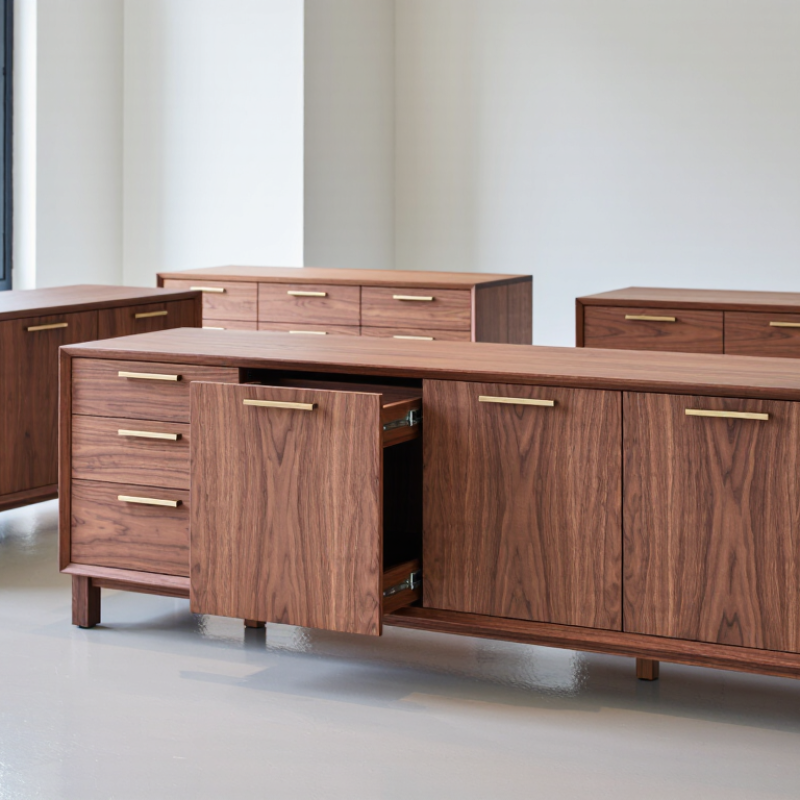
Choosing among China’s top Solid Wood Credenza manufacturers requires more than comparing photographs and quoted prices. A convincing catalog may show walnut doors, brass handles, and smooth cabinet lines, yet reveal little about timber sourcing, moisture control, or construction quality. This guide examines manufacturers through practical evidence, including factory capability, material consistency, joinery, finishing methods, customization support, and export experience.

Details matter. A reliable producer should explain whether the cabinet uses solid panels, veneered substrates, or mixed materials. Buyers should also ask about kiln-dried wood, panel movement, drawer hardware, edge treatment, and finish durability. Clear samples can expose differences that digital images conceal. Physical inspection remains valuable.

No ranking can replace careful verification. Even an experienced buyer may overlook packaging strength or small changes between approved samples and mass production. That weakness deserves attention. Factory audits, reference projects, inspection reports, and written specifications can reduce uncertainty without pretending to remove it. Manufacturers with consistent communication usually make problems easier to solve.

The following overview highlights reputable Chinese suppliers and the qualities that distinguish them. It considers design flexibility, production scale, craftsmanship, quality-control procedures, sustainability documentation, and delivery coordination. Readers can use these factors to compare manufacturers for hospitality, residential, office, and retail interiors. The strongest choice may not be the cheapest. It should be the one that balances honest materials, dependable workmanship, responsive service, and verifiable performance.

China Top Solid Wood Credenza Manufacturers?

What Defines a Top Solid Wood Credenza Manufacturer in China

China Top Solid Wood Credenza Manufacturers?

What Defines a Top Solid Wood Credenza Manufacturer in China

A top manufacturer proves material quality before discussing price. In factory audits, I check timber moisture, board thickness, joint strength, and finishing consistency. Wood moves. A reliable supplier controls kiln drying and records moisture readings for each batch. The FAO Forestry Production and Trade Yearbook 2023 shows China remains one of the world’s largest wood-product manufacturing and trading centers. This scale creates strong capacity, but it does not guarantee craftsmanship.

Credenza production should include documented inspections. Look for checks on cabinet squareness, drawer alignment, hardware torque, surface adhesion, and packaging protection. China Customs data recorded roughly US$70 billion in furniture and furniture-part exports in 2023. That figure indicates mature supply-chain capability, not automatic reliability. ISO 9001 certification can support process control, according to the ISO Survey 2023, but buyers should still review recent inspection records and corrective-action reports.

A strong manufacturer also explains wood sourcing clearly. FSC or equivalent chain-of-custody documentation can improve traceability, although certificates should be verified against the actual factory and product scope. I would request a pre-production sample, then compare it with the mass-production unit. Small differences often reveal weak supervision. The imperfect part is unavoidable: natural grain, knots, and slight color variation will occur. The real test is whether the supplier defines acceptable variation before production, photographs every approval point, and responds honestly when a defect appears.

China’s Main Solid Wood Credenza Manufacturing Regions

China Top Solid Wood Credenza Manufacturers?

China’s Main Solid Wood Credenza Manufacturing Regions

Nankang in Jiangxi is a major solid wood furniture hub. Its factories often handle oak, rubberwood, pine, and mixed hardwood projects. Local workshops range from small family operations to export-focused production lines. Buyers can usually find flexible sizing, custom finishes, and competitive batch pricing. However, quality varies widely between neighboring factories. A polished showroom does not always reflect production consistency.

Foshan and Shunde in Guangdong offer stronger support for design, hardware, finishing, and export logistics. These areas suit buyers seeking modern credenzas with drawers, sliding doors, or refined lacquer work. Jiangsu and Zhejiang also have capable manufacturers, especially for engineered production and detailed joinery. Their strengths can differ by city, so regional labels alone are not enough. I would inspect kiln-drying records, moisture readings, panel construction, and edge details before placing an order.

Tips: Request a sample before mass production. Check the wood species in writing. Ask whether the back panel uses solid wood or veneer. Photograph the carton, corner protection, and hardware during approval. A factory may promise “solid wood” while quietly combining solid frames with veneered panels. That is not always poor practice, but the specification must stay clear. Allow time for finish testing, because color can change under different lighting.

Key Materials and Construction Standards to Compare

A reliable solid wood credenza starts with the timber specification, not the finish. Ask whether the frame uses oak, ash, rubberwood, or another species, and request moisture readings before production. The Forest Resources Assessment 2020, published by FAO, reports that global forests cover about 4.06 billion hectares. That figure does not prove responsible sourcing. Suppliers should still provide traceable documentation, legal harvest records, and a clear grading method.

Look closely at construction details. Solid wood panels need allowance for seasonal movement, especially around wide doors and tops. A strong unit usually combines properly oriented grain, mortise-and-tenon or reinforced dowel joints, adjustable hinges, and a level-resistant plinth. Check drawer testing, door-cycle results, and load capacity. ISO 7170 covers storage furniture performance, including stability and strength testing. Yet certificates alone can be incomplete. I would inspect the rear panel, screw seating, and corner joints personally.

Finishing standards also deserve careful comparison. Measure coating thickness, adhesion, and resistance to water rings, heat, and household chemicals. If engineered wood appears in the back or drawer base, request formaldehyde test results. The U.S. EPA’s TSCA Title VI rule sets emission limits for composite wood products, with particleboard limited to 0.09 ppm and MDF to 0.11 ppm. These values may not apply to every market, but they offer a useful benchmark. A beautiful surface can hide weak materials. That is where buyers often underestimate risk.

China Top Solid Wood Credenza Manufacturers? - Key Materials and Construction Standards to Compare

A practical specification checklist for comparing solid wood credenza suppliers without relying on brand names.

Comparison Area Recommended Benchmark Applicable Standard or Reference Evidence to Request Why It Matters
Primary Wood Material Clearly identify the species, such as oak, ash, beech, rubberwood, walnut, or acacia. Avoid descriptions that only state “wood” or “wooden finish.” Wood species should be identified using its accepted common name and, where needed, botanical name. Material declaration, purchase specification, and representative cross-section photographs. Different species vary substantially in density, hardness, grain stability, color, and price.
Solid Wood Content Specify which components are solid wood and which are plywood, MDF, particleboard, veneer, metal, or glass. A credenza may legitimately combine several materials. The bill of materials should distinguish solid wood from wood-based panels and decorative veneer. Bill of materials, annotated drawings, and a sample inspection of doors, legs, top, back, and internal shelves. Transparent material allocation prevents misleading “100% solid wood” claims.
Moisture Content For indoor furniture in typical conditioned environments, kiln-dried wood is commonly targeted around 6–8% moisture content, subject to the destination climate and species. Moisture measurement should follow a calibrated electrical resistance or capacitance moisture meter procedure suitable for the species. Moisture inspection records taken from multiple parts of the finished product before packing. Incorrect moisture levels can contribute to shrinkage, swelling, splitting, warping, and joint opening.
Wood Drying and Conditioning Use kiln-dried lumber followed by sufficient conditioning, machining, and acclimatization before final assembly. The supplier should maintain documented kiln schedules and internal moisture-control procedures. Kiln records, production control plan, and nonconformance records for warped or split parts. Drying quality is a major determinant of dimensional stability and long-term fit.
Panel Construction For wide tops and doors, consider frame-and-panel construction, edge-glued boards, or stable wood-based panels with appropriate solid-wood edging. Wood movement should be accommodated instead of restraining wide solid-wood panels rigidly on all sides. Construction drawings showing floating panels, elongated screw holes, clips, or other movement-control details. Solid wood expands and contracts across the grain as relative humidity changes.
Joinery Use well-fitted mortise-and-tenon, dowel, spline, or reinforced screw-and-dowel joints according to the load and design. Joint design should be validated through prototype inspection and furniture performance testing. Exploded drawings, joint samples, adhesive specifications, and assembly work instructions. Appropriate joinery improves racking resistance, repairability, and service life.
Adhesives Specify the adhesive type, open time, press time, curing conditions, and application quantity for each relevant joint. Adhesive selection should match the intended indoor environment and the substrates being bonded. Technical data sheet, safety data sheet, batch records, and internal bond-quality inspection results. Poor bonding control may cause delamination, joint failure, or visible glue lines.
Back Panel and Shelves Define back-panel thickness, attachment method, shelf thickness, shelf-pin diameter, adjustability, and allowable load. Performance requirements should be agreed in the purchase specification because shelf capacity is product-specific. Dimensioned drawings, shelf-load test results, and photographs of shelf supports. Thin or poorly supported panels can sag, loosen, or reduce the cabinet’s racking resistance.
Hardware and Door Operation Use corrosion-resistant hinges, accurately aligned runners, adjustable feet, and hardware rated for the door or drawer mass. Hardware should be evaluated through repeated-cycle, alignment, and load testing appropriate to the product. Hardware specifications, cycle-test records, adjustment instructions, and spare-parts policy. Reliable hardware improves usability, alignment retention, and repairability.
Surface Finish Specify finish type, sheen, color tolerance, coating build, edge coverage, and resistance requirements for water, household chemicals, and abrasion. Common evaluation methods include ASTM D3359 for coating adhesion and ASTM D4060 for abrasion resistance, when applicable to the coating system. Finish sample, approved color standard, coating technical data sheet, and laboratory test report. A durable finish protects the wood and maintains appearance during normal household use.
Formaldehyde and VOC Control For products containing composite panels or wood adhesives, require documented emissions compliance for the destination market. U.S. requirements commonly reference TSCA Title VI or CARB Phase 2; Europe commonly uses EN 717-1 for formaldehyde emission testing. Current third-party test reports, panel supplier certificates, and product-material traceability. Compliance depends on the actual panels, adhesives, coatings, and destination-market requirements.
Responsible Wood Sourcing Where sustainability claims are required, use traceable certified material or provide a documented legal-sourcing chain. Recognized chain-of-custody systems include FSC and PEFC, subject to the scope of the certificate. Valid certificate number, certificate scope, transaction documents, and species/source declaration. Certification claims must cover the relevant material and product flow, not only the factory generally.
Dimensional Tolerances Set written tolerances for overall dimensions, panel gaps, door alignment, squareness, flatness, and finish variation before production. Tolerances should be product-specific and agreed on an approved technical drawing rather than assumed. Golden sample, inspection checklist, measurement records, and approved limit samples. Clear tolerances reduce disputes and make supplier-to-supplier comparisons measurable.
Structural and Stability Testing Require stability, static-load, door/drawer-cycle, and racking evaluations appropriate to the credenza’s intended use. ASTM F2057 is relevant to clothing storage units; other furniture performance methods may be selected according to product type and market. Independent laboratory report or controlled internal test report with test setup, loads, cycles, and failures recorded. Aesthetic quality alone does not demonstrate resistance to tipping, racking, or repeated use.
Packaging and Export Readiness Use corner protection, moisture-resistant wrapping, abrasion barriers, drop protection, and packaging designed for the shipping route. Wood packaging used in international trade may need ISPM 15 treatment and marking requirements. Packaging specification, carton test results, packing photos, and ISPM 15 documentation where applicable. Adequate packaging reduces corner damage, finish scratches, moisture exposure, and transit claims.
Quality-Control System Require incoming-material inspection, first-piece approval, in-process checks, final inspection, and corrective-action records. ISO 9001 certification can support process control, but it does not replace product-specific inspection or testing. Quality manual, inspection plan, sample records, calibration certificates, and corrective-action reports. A documented system helps maintain consistency across batches and purchase orders.
Buyer’s note: Standards and target values should be confirmed against the destination country, product configuration, wood species, and intended use. Request current, product-specific documentation rather than relying only on general factory certificates.

How Leading Manufacturers Handle Customization and Quality Control

Leading solid wood credenza manufacturers in China treat customization as a controlled engineering process, not a cosmetic service.

Buyers may submit drawings, room dimensions, wood preferences, hardware details, and finish samples. Experienced teams convert these inputs into production drawings with joint locations and tolerance notes. A practical review should cover door swing, cable routing, shelf loads, and cleaning access.

Small oversights become expensive after tooling begins. Details matter. One missed measurement can alter an entire room.

Prototype & Approval

Reliable workshops usually prepare a prototype or approval sample before full production. Technicians check board moisture with calibrated meters, targeting a stable range for the destination climate. They inspect grain direction, knots, color variation, and panel movement.

Joinery is tested by fitting doors and drawers repeatedly. Finishing staff compare the surface with an agreed sample under neutral light. The result should be recorded, not judged from memory.

Photos, inspection sheets, and batch numbers support traceability.

Quality Control & Shipment

Quality control continues after assembly. Inspectors measure gaps, check hardware alignment, test stability, and examine concealed surfaces.

Packaging tests matter because a flawless cabinet can still arrive with crushed corners.

Reputable manufacturers welcome third-party inspections and retain corrective-action records.

No process is flawless. Even skilled teams may miss a minor sheen difference or slight warp.

That weakness deserves review, not denial. Buyers gain confidence when factories explain limits, revise drawings, and document every change before shipment.

How to Evaluate Suppliers, Pricing, and Export Capabilities

Evaluating China’s Top Solid Wood Credenza Manufacturers

Supplier evaluation should begin with evidence, not showroom photography. CSIL’s World Furniture Outlook 2024 places Asia at roughly 55% of global furniture production. This scale creates choices, but also uneven quality. Request factory audit records, recent export invoices, and photos of kiln rooms. Solid wood should include species, moisture readings, and joint construction. A useful target is 8–12% moisture for conditioned interiors. Confirm it with a meter before shipment. I learned that attractive walnut grain can hide unstable boards. Appearance is not enough.

Pricing needs a clear cost structure. Ask for separate figures for timber, labor, hardware, packaging, inspection, and freight. Compare identical dimensions and wood grades. Otherwise, the lowest quote may simply exclude essential components. UN Comtrade HS 940360 records can help benchmark furniture trade values, although classification is imperfect. Treat the data as guidance, not proof. A credible supplier should explain price changes caused by timber availability, exchange rates, and container costs.

Export capability matters as much as craftsmanship. The World Bank’s 2023 Logistics Performance Index gave China an overall score of 3.7, ranking it 19th globally. This supports strong logistics infrastructure, but one factory may still lack experience with your destination. Request packing specifications, fumigation documents when applicable, loading photos, and a sample bill of lading. Check whether cartons protect corners and prevent finish abrasion. Small details often decide whether a credenza arrives ready for resale.